
We’ve already explained here why we chose to focus our work on combating climate emergencies.
These were not easy choices. Developing a strategy requires tackling the most complex issues, sharpening one’s perspective, and practicing active listening. It was clear from the very beginning that we needed to find a new center of balance to develop ideas and find solutions to the long-standing problems that have brought us to this point.
The clues and hints for finding this new center were all there. And we arrived at Amazonizar.
But when we talk about this, a lot of people don’t understand. There are many of us, from different places, but we aren’t an organization that originated in the Amazon.
What are we trying to say? Can we say it?
To test the concept, it was fun to ask an AI: What does “amazonize” mean?
The answer, for now, reflects what people don’t know about it:“Amazonize may refer to a business strategy that seeks to emulate or imitate Amazon’s business model.”
This speaks volumes about the need to change our frame of reference and standards. We understand that we need to live by and promote this concept, since it can provide solutions rooted in ancestral wisdom—a new way of relating to the world in which we live.
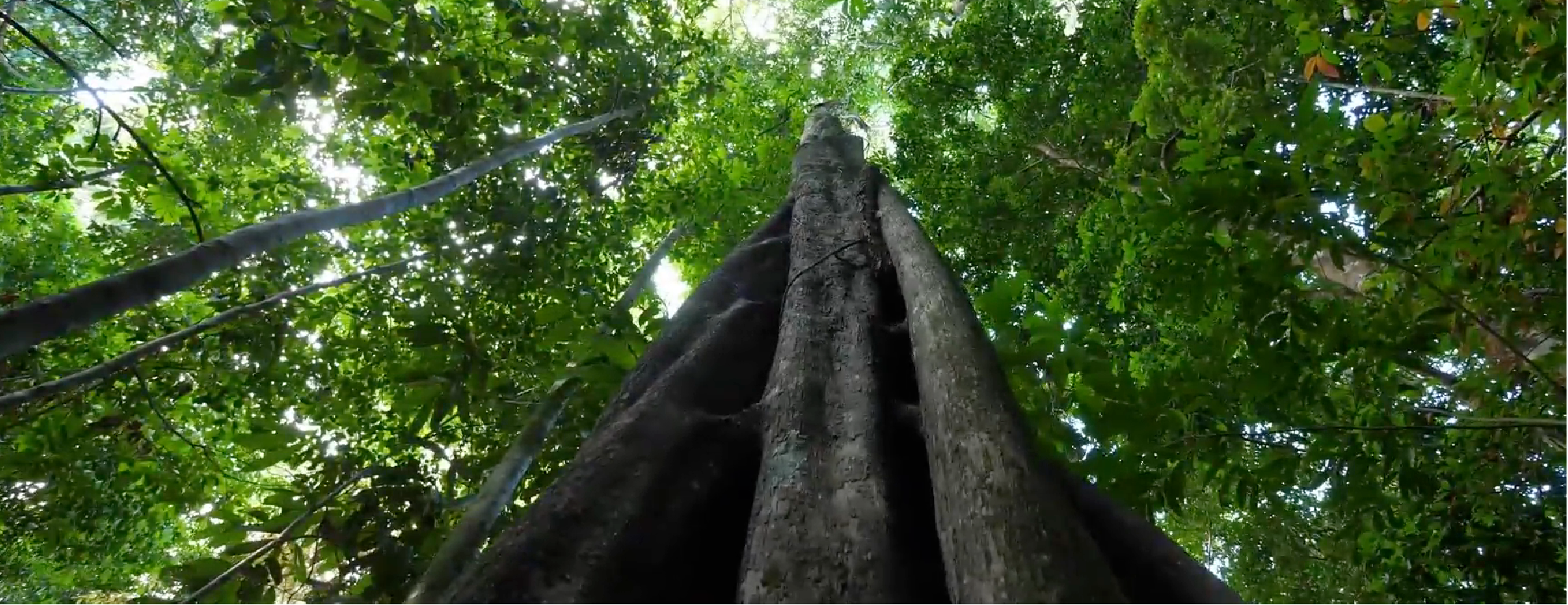
The wisdom of the forest must guide our choices and decisions—no matter where we are. Political, social, and economic decisions; decisions about health and relationships.
In her book *Banzeiro Òkòtó* (p. 50), when explaining the term “amazonizar,” Eliane Brum says: “What I mean is that reforestation—or ‘amazonizing’—is a radical movement.”
The idea of taking a radical approach can be expanded by considering that a profound shift in perspective—in the very structure of our thinking—is necessary. This highlights the need to discuss everything: from production, through social structure, to consumption and other pillars of how society functions. And from there, to bridge the gap between the Amazon and the rest of Brazil and the world—to recognize that many answers and actions to combat climate collapse lie in the Amazon, with the people and nature (both human and non-human, as Eliane Brum also puts it). In the context of the climate super-emergency, the Amazon is, in effect, the center of the world.
"Amazonization" is strategic for our ecosystem
Bringing the Amazon to the forefront in a context as challenging as this one does not mean merely dealing with limitations; rather, it means thinking in terms of abundance and creative, integrated solutions that make use of what is available to us. Everyone can benefit from this process, because it is, above all, strategic.
We are “Amazonizing” by expanding our image archives and knowledge production, strengthening relationships with organizations and activists on the ground, and working side by side with professionals from the Amazon. As director Caio Coimbra aptly put it: “If it’s exclusionary, it’s not ‘Amazonizing.’” Here we highlight three key points:
1- Consider the context of speech and action in an inclusive and pluralistic manner
The Amazon Viva Network was a project developed in 2022 in partnership with a major cosmetics company. The goal was to build a network of activists, scientists, and people with varying levels of knowledge and involvement in issues related to these territories in order to advance local causes. One of our main challenges was creating a Twitter profile that could explain more technical issues—such as the impacts of deforestation on daily life—to the network’s audience, while also participating in conversations that were trending at the time, such as the presidential elections.
To “Amazonize” our communication strategy on this network, we brought in professionals from the region to develop the strategic plan, produce the content, and monitor the results. This resulted in a collaborative project featuring a wide range of perspectives, all of which were reflected in how we addressed our key audience: “We are the Living Amazon,” a phrase that embodies the diversity we seek—a region with more than 25 million inhabitants, comprising many languages, accents, and ways of life.
2- New solutions, new perspectives
Because it serves as a lens through which we view our work, it is also possible to “Amazonize” projects that are not necessarily located in the Amazon. Placing local actors at the center is also a form of “Amazonization.” “Northeast Power” is an initiative that promotes public debate on post-pandemic economic recovery and green energy in Brazil’s Northeast, based on principles of fairness and inclusion. As part of this initiative, the “Northeast Power Caravan” was launched—a web series that traveled along the São Francisco River, highlighting its importance to the region and its potential to drive economic transformation.
The perspective we apply links natural resources as drivers of equitable development with the relationship that people establish with these places, and the promotion of a green economy… All of these are lessons that the Amazon teaches us and that can be applied to other regions of Brazil.
3- Listen to and incorporate knowledge from the regions
It is increasingly common to advocate for the leading role of traditional peoples and communities, but implementing truly active listening is, without a doubt, our main obstacle to “Amazonizing.” Developing strategic solutions and co-creating projects requires moving beyond paternalism to recognize that the people who keep the Amazon standing have value.
How willing are we, in fact, to listen to what indigenous peoples and traditional communities have to say? Are we truly taking into account their rhythms, their ways of communicating, and their priorities?
This conversation, here at Apply, is a starting point. We want to do our part to ensure that the peoples of the region take the lead, and we know it’s not an easy path. We still have a lot of work to do, but learning from the Amazon means discovering new solutions, and we encourage our partners to join this effort.
And what about you? What does “Amazonizing” mean, and how can you put it into practice in your day-to-day work?